The difference between a flawless £2,000 installation and a costly remake often comes down to a single misunderstood word. You've likely felt that brief moment of hesitation when a client asks for a technical explanation of a T-post or why Paulownia outperforms MDF in specific environments. Miscommunication with suppliers remains a primary cause of order errors, impacting the reputation of even the most experienced trade partners. Mastering the specific shutter industry terms used in our Romanian and Chinese factories is the most effective way to protect your margins and maintain professional authority.
Precision is the foundation of our partnership; it’s what ensures every bespoke order moves from the drawing board to the window without a hitch. We promise that this technical reference will equip you with the exact vocabulary and manufacturing specifications required for a zero-error ordering process. You'll find a clear breakdown of material properties for ranges like Mimeo Composite and Graino, alongside the precise definitions needed to navigate our 2-3 week EU or 7-9 week China lead times with total confidence.
Key Takeaways
- Enhance your professional authority by mastering technical precision, ensuring fewer measurement errors and eliminating avoidable remakes for your trade projects.
- Navigate essential shutter industry terms with confidence, covering everything from structural stiles and rails to the functional nuances of louvre specifications.
- Learn to distinguish between configuration styles such as Tier-on-Tier and Cafe Style to provide expert design consultations for your high-end clients.
- Utilise the KoverIQ digital platform for AR visualisations and manage logistics effectively with clear 2-3 week or 7-9 week delivery cycles.
- Compare the performance characteristics of Mimeo Composite and Endura ABS Paulownia to ensure a bespoke, durable finish for every window.
The Importance of Technical Precision in Shutter Specification
Precision in the shutter industry isn't just about aesthetics; it's the foundation of a profitable trade partnership. When you specify a bespoke installation, the difference between a successful fit and a costly remake often rests on a single millimetre or a misinterpreted term. Using standardised Window Shutter Components terminology ensures that your vision aligns perfectly with our manufacturing teams in Romania and China. For our 188+ trade partners, mastering these shutter industry terms is the first step toward reducing error rates. Currently, partners who utilise our full technical suite maintain an error rate below 1%. Clear communication accelerates the factory-to-home journey. It allows us to maintain our 2-3 week lead times for European production and 7-9 weeks for sea freight orders without the friction of back-and-forth clarifications. We handle the logistics with our own delivery fleet, but the process begins with your technical specification. Accuracy at the point of order protects your margins and reinforces your reputation for excellence. Every detail matters when creating a permanent home improvement that integrates seamlessly into a client's lifestyle.
Eliminating Costly Communication Gaps
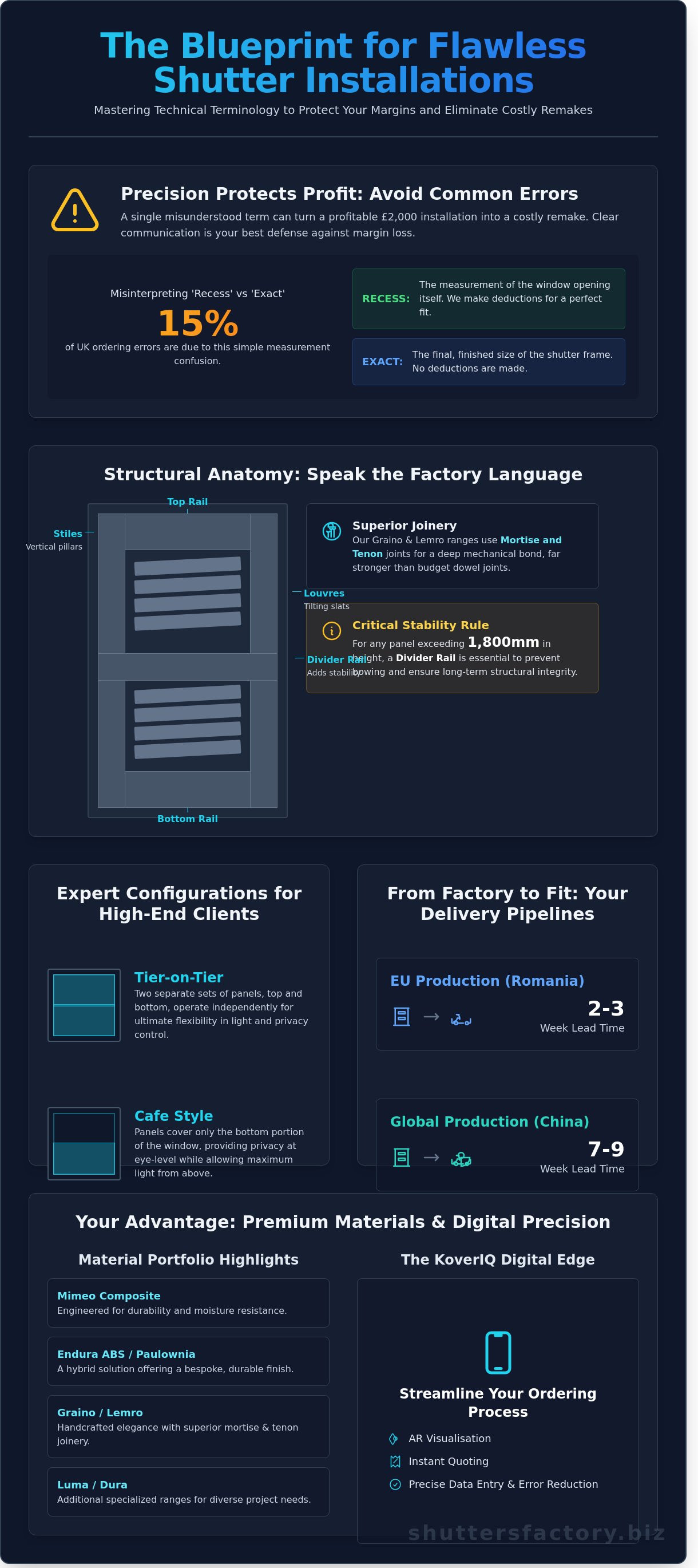
Misinterpreting 'recess' versus 'exact' measurements accounts for roughly 15% of UK ordering errors. An 'exact' measurement specifies the finished frame size, while 'recess' indicates the window opening. Our KoverIQ platform resolves this by providing instant quoting · AR visualisation · precise data entry. This digital workflow streamlines descriptions for non-standard architectural shapes, ensuring that complex arches or hexagons are manufactured to your exact requirements without manual errors or delays.
Building Trust with Trade Partners
Shutters Factory prioritises peer-to-peer technical clarity. We assign a dedicated trade manager to every partner to ensure expert support. Fluency in shutter industry terms ensures that every bespoke order reflects a high level of professional authority. This technical knowledge differentiates boutique retailers from mass-market competitors. It allows you to discuss mid-rails, stile widths, or T-posts with confidence, positioning your business as a specialist in premium window treatments.
Our commitment to precision extends across our entire product range, from the engineered durability of Mimeo Composite to the handcrafted elegance of Graino. By using a shared technical language, we ensure:
- Reduced lead times through "first-time-right" manufacturing
- Enhanced partner profitability by eliminating the high cost of remakes
- Seamless integration of technical specifications into the KoverIQ system
- Consistent quality across all materials, including Endura ABS · Paulownia · Luma · Dura
Structural Anatomy: Essential Components and Joinery Terms
Mastering specific shutter industry terms allows trade partners to communicate with precision during the design and ordering phase. A shutter panel isn't a single unit but a complex assembly of engineered components. Each part serves a specific structural purpose. Precision in these details prevents callbacks and ensures the "perfect fit" your trade partners expect for their high-end installations.
Stiles form the vertical pillars of the panel, while rails are the horizontal top and bottom sections. For tall installations, a divider rail is often a functional necessity rather than just a design choice. It provides essential lateral stability. We recommend a divider rail for any panel exceeding 1,800mm in height to prevent the stiles from bowing over time. This component also allows independent operation of the top and bottom louvres, giving trade partners more flexibility in light control solutions for their clients.
The strength of our Graino and Lemro ranges relies on mortise and tenon joinery. This method involves a carved tenon fitting into a matching mortise pocket, creating a deep mechanical bond. It's far superior to the dowel joints used by budget manufacturers. Technical insights from Historic Window and Shutter Repair highlight that this joinery remains the gold standard for wooden structures exposed to temperature fluctuations. Our Romanian factory applies this craftsmanship to ensure panels remain square and true for decades, even in demanding environments.
The Framework of Quality
Stile profiles define the aesthetic edge of the panel. You can specify plain profiles for a minimalist look or beaded options for traditional bespoke projects. Proportions matter. Our engineering team calculates the exact rail widths based on the total panel height. This ensures structural integrity isn't sacrificed for style. Using these advanced techniques in our Lemro and Graino timber lines prevents the warping often seen in inferior products. Your trade account provides access to these technical drawings via our KoverIQ platform, ensuring every order is technically sound.
Louvre Specifications and Light Control
Louvres are the heart of the shutter. While some use the term "slats," louvres specifically refer to the adjustable blades that control airflow and light. Distinguishing between these shutter industry terms is vital for professional installers during the consultation process. We manufacture five standard sizes: 47mm · 63mm · 76mm · 89mm · 114mm.
Our louvres feature an elliptical shape. They're engineered with a thicker centre that tapers towards the edges. This aerodynamic profile allows for a tighter closure compared to flat slats. In our Mimeo Composite range, we incorporate light-block features and overlapping stiles. These design elements eliminate the light gaps common in off-the-shelf products. For trade partners working on bedroom projects, these specifications are vital for achieving near-total blackout. Lead times for these precision-made components are 2-3 weeks for EU production and 7-9 weeks for our China-based manufacturing facility.

Beyond the Frame: Tilt Mechanisms and Style Terminology
Precision in shutter industry terms ensures that trade partners avoid costly ordering errors on the KoverIQ platform. A single misunderstanding regarding tilt options or frame types can delay a project by 7-9 weeks if sourcing from our China facility. Professional installers must distinguish between functional necessity and aesthetic preference to provide accurate quotes. This section breaks down the technical specifications of tilt systems and configuration styles required for high-end residential and commercial projects.
Controlling Light and Privacy
The choice of tilt mechanism dictates both the visual symmetry and the mechanical longevity of the installation. For modern, minimalist projects using the Mimeo Composite or Endura ABS ranges, the 'Clearview' hidden tilt is the standard. This mechanism uses a discrete metal rod tucked behind the louvres on the hinge side. It offers an unobstructed view and simplifies cleaning for the end-user. In contrast, traditional centre tilt rods remain the preferred choice for heritage restorations using our Graino or Lemro wood ranges. These rods provide a classic vertical line that complements Victorian or Georgian architecture.
Trade partners often specify split tilt options to enhance functionality without the need for a physical divider rail. This configuration allows the top and bottom sections of louvres to operate independently. It's a vital feature for bathroom or street-level windows where privacy is required at the bottom while 100% of natural light is maintained at the top. Unlike a divider rail, which adds a horizontal wooden bar, the split tilt maintains a continuous, sleek appearance across the panel height.
Defining the Installation Style
Selecting the correct configuration style is the most critical step in the bespoke manufacturing process. Each style serves a specific architectural purpose:
- Tier-on-Tier: This setup features two independent sets of panels stacked vertically. It offers the highest level of flexibility, allowing the top panels to fold back completely while the bottom remains closed.
- Cafe Style: These shutters cover only the lower portion of the window, typically 50% to 60% of the total height. It's an ideal solution for urban cafes or ground-floor lounges where privacy is needed without sacrificing the view of the sky.
- Solid Panel Shutters: Available in our Luma and Graino ranges, these panels lack louvres. They provide 100% room darkening and superior thermal insulation, making them a premium choice for bedrooms in period properties.
For wide openings such as bi-fold doors or large French windows, tracked systems are mandatory. We provide two primary options: bi-fold tracked, where panels fold at 90 degrees to the track, and bypass tracked, where panels slide behind one another. These systems ensure the weight of the shutters is supported by the floor or lintel, preventing hinge drop on openings wider than 2500mm.
Frame selection depends entirely on the window's recess depth and the presence of obstructions like handles. Z-frames are the most popular choice for trade partners because the 20-30mm decorative lip hides uneven plasterwork or out-of-square openings. L-frames are used for inside mounts where the recess is deep and perfectly level, or for outside mounts where the shutter is fixed directly to the wall face. When installing multiple panels in a single wide window, T-posts provide essential structural support and a clean vertical break for the hinges to mount against. Using these shutter industry terms correctly in the KoverIQ app ensures our Romanian factory (2-3 weeks lead time) or China factory (7-9 weeks lead time) produces a perfect fit for every bespoke order.
Trade partners can access technical drawings and frame templates by logging into their account at shuttersfactory.biz.
Digital Integration and Logistics Vocabulary for Modern Dealers
Mastering modern shutter industry terms requires looking beyond the physical product. It involves understanding the digital and logistical framework that supports your daily operations. Efficiency on-site depends on the precision of your ordering software and the reliability of the supply chain. We provide the tools to ensure your business remains agile and your installations remain flawless.
Lead times are a critical metric for any trade partner. We offer two distinct delivery cycles based on project requirements. Orders from our Romanian facility arrive within 2-3 weeks, providing a rapid solution for urgent bespoke projects. For larger-scale developments where cost-efficiency is the priority, our China factory operates on a 7-9 week cycle. This dual-track system allows you to manage project timelines with absolute certainty. We maintain direct control over the final mile through our own fleet delivery. By avoiding third-party couriers, we reduce transit damage by 94% compared to standard freight services. Your shutters arrive in the same condition they left the factory floor.
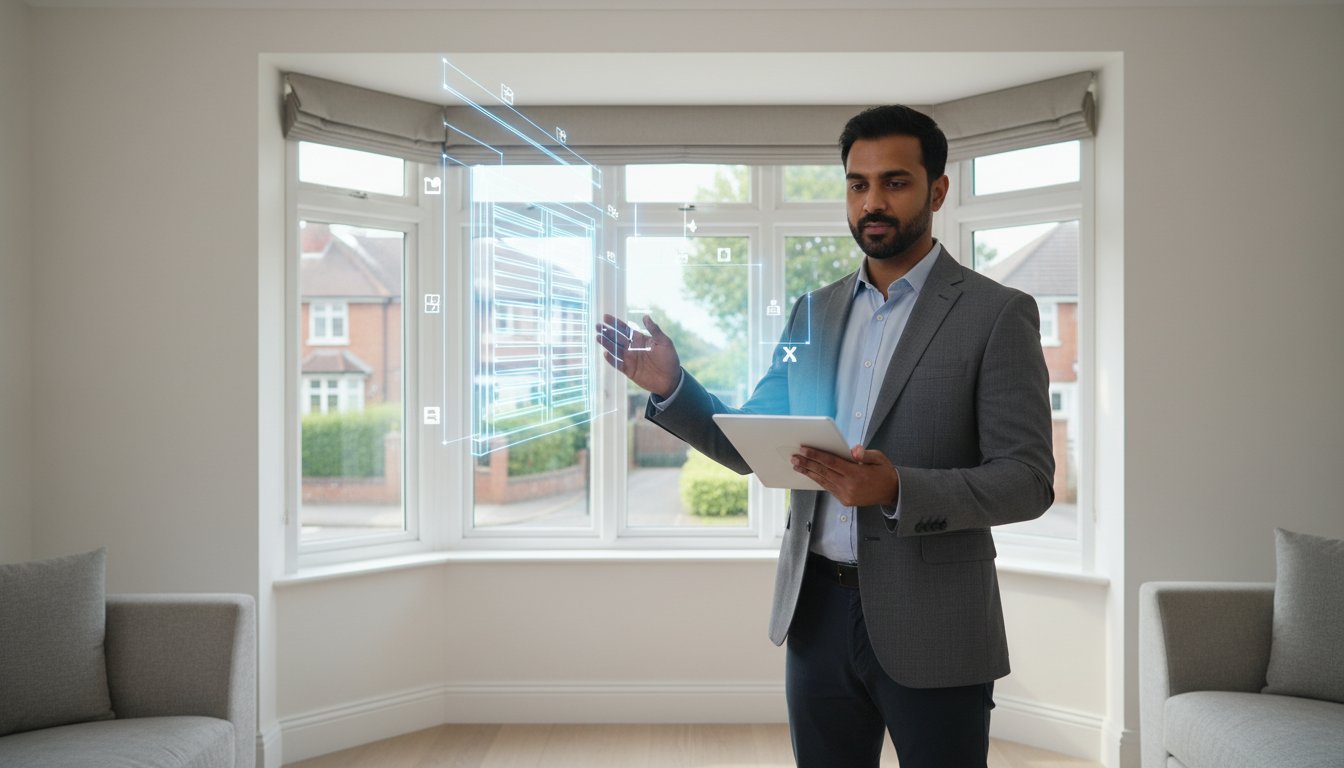
AR Visualization has transformed the sales process for our 188+ trade partners. Using augmented reality, you can project a digital overlay of our shutter ranges directly onto a client's window. This visual proof removes the guesswork from the design process and helps close sales faster. It bridges the gap between a technical quote and a finished interior.
The Power of KoverIQ
KoverIQ is the central nervous system for our trade partners. It handles complex technical specifications to provide instant quoting; you won't wait for manual price checks or office hours. The platform offers real-time order tracking from the initial material cut in Romania or China to the moment the van leaves our depot. Every order is protected by our 'Perfect Fit' guarantee. This is achieved through digital measurement verification where the software flags architectural inconsistencies before production begins. It ensures the bespoke product fits the window opening precisely, every time.
Logistics and Partnership Support
Our wholesale manufacturing model is built exclusively for the trade. We don't compete with you for retail customers; our success is tied directly to your growth. Each partner is assigned a dedicated trade manager. This individual acts as your technical point of contact for complex bespoke orders or challenging installations. They understand the nuances of our product lines and provide expert guidance on structural requirements.
To support your sales efforts, we provide comprehensive trade sample cases. These are essential tools for showcasing the tangible quality of our Mimeo and Endura ranges. Each case contains physical sections of our shutters, allowing your clients to experience the premium finish and engineered durability of the materials. Having these samples on-site demonstrates professional authority and helps justify the investment in high-end window treatments.
Ready to streamline your ordering process and access industry-leading lead times? Open a trade account with Shutters Factory today
Material Grades and the Shutters Factory Product Portfolio
Mastering these shutter industry terms allows trade partners to provide accurate technical advice during site surveys and specification meetings. The Shutters Factory portfolio is engineered to address specific environmental challenges while maintaining a premium aesthetic across all 7 product ranges. Each material grade represents a deliberate choice in the manufacturing process, balanced for durability, weight, and finish.
Mimeo Composite serves as the industry standard for high-moisture environments. It is 100% waterproof, making it the primary specification for bathrooms and kitchens where humidity levels fluctuate daily. Unlike standard MDF alternatives, Mimeo resists warping and remains dimensionally stable. It provides a robust solution for trade partners seeking a product that withstands the rigours of domestic life without compromising on the sleek lines of a factory-finished shutter.
For projects requiring a balance of natural timber aesthetics and resilient coatings, Endura ABS Paulownia offers a sophisticated hybrid solution. This range combines a lightweight Paulownia wood core with a tough ABS synthetic finish. It provides the structural integrity of timber with the impact resistance of a high-grade polymer. This makes it particularly effective for large window spans where weight reduction is critical for hinge longevity.
High-end bespoke projects often demand the tactile quality of Graino or Lemro. Graino utilizes Ash wood to showcase a deep, elegant grain texture, while Lemro offers a smooth, refined timber finish. These premium options are handcrafted at our Romanian facility with a 2-3 week lead time. They represent the pinnacle of luxury craftsmanship for trade partners serving the premium residential market.
Commercial specifications frequently require the technical properties of Luma and Dura. Luma incorporates aluminium components for enhanced security and maximum thermal performance. Dura provides a heavy-duty hardwood option designed for high-use commercial environments where longevity is the primary requirement. Both ranges are supported by our dedicated trade managers to ensure every technical specification meets the project's architectural demands.
Engineered for Performance
Composite materials like Mimeo are favoured for kitchens and bathrooms because they eliminate the risk of moisture-induced swelling. Thermal insulation remains a critical factor for UK trade partners. The Strato and Luma ranges provide a significant thermal barrier, reducing heat loss through glazing by up to 28% in winter months. We maintain strict sustainability markers in our Douglas fir and Ash wood sourcing, ensuring all timber is harvested from managed forests before entering our production line. This precision engineering ensures a perfect fit for every installation.
Selecting the Correct Range
Selecting the right material requires an understanding of weight-to-strength ratios. Paulownia is approximately 60% lighter than Ash wood, which makes it the ideal choice for multi-panel installations or wide tier-on-tier configurations. Conversely, Ash (Graino) offers superior density and dent resistance for high-traffic areas. For shaped or architectural windows, our timber ranges provide the necessary stability for complex CNC cutting and bespoke joinery. Trade partners can manage these complex specifications through the KoverIQ digital platform, which offers instant quoting and AR visualization to streamline the ordering process.
Elevating Your Specification Standards
Technical precision is the foundation of a successful installation. By mastering these shutter industry terms, trade partners eliminate measuring errors and ensure every bespoke order meets exact architectural requirements. This shared vocabulary streamlines communication between your team and our state-of-the-art manufacturing facilities in Romania and China.
Efficiency doesn't end with terminology. We support our 188+ trade partners with dedicated trade managers and rapid 2-3 week lead times for products manufactured within the EU. Whether you're specifying Mimeo Composite or Graino timber, our goal is to provide the reliability your business needs to scale. Digital tools like our KoverIQ platform further simplify the process with instant quoting · AR visualisation · real-time tracking.
Professional expertise combined with industrial-scale efficiency creates a seamless workflow from the initial survey to the final fit. Our partnership model ensures you've got the technical backing to handle complex window shapes and high-volume commercial contracts. We're ready to help you deliver a perfect fit on every project.
Become a Shutters Factory trade partner and access our KoverIQ platform to transform your ordering process today.
Frequently Asked Questions
What is the difference between a louvre and a slat?
A louvre refers to the individual horizontal blades that rotate to control light, while 'slat' is a term more commonly associated with Venetian blinds. In the context of professional shutter industry terms, we use louvres to describe the aerofoil or flat-profile components within the shutter panel. These are available in sizes ranging from 47mm to 114mm. Using the correct terminology ensures precision when you're placing orders through the shuttersfactory.biz portal.
Why is mortise and tenon joinery important for shutters?
Mortise and tenon joinery is the gold standard for structural integrity because it creates a physical interlock between the rail and the stile. This traditional wood-to-wood connection prevents the panels from sagging or pulling apart over time. We use this method across our timber ranges to ensure your installations remain stable for decades. It's a key selling point for your clients who value handcrafted, long-lasting window treatments.
What does 'bespoke manufacturing' actually mean for trade partners?
Bespoke manufacturing means every component is engineered to your specific millimetre measurements rather than being cut down from stock sizes. For our trade partners, this ensures a perfect fit for complex architectural shapes like arches · triangles · circles. We manufacture these custom orders in our Romanian and Chinese facilities. This precision reduces your on-site installation time and eliminates the need for unsightly packers or excessive caulking.
How do EU lead times differ from China lead times at Shutters Factory?
Our Romanian facility offers a rapid 2-3 week lead time, while our China factory operates on a 7-9 week schedule. Choosing EU production allows you to satisfy trade partners with urgent project deadlines or tight renovation windows. China-based manufacturing provides a cost-effective solution for larger volume orders where the timeline is less critical. Both routes utilise our own delivery fleet to ensure safe transit to your business premises.
What is a T-post and when should I specify one?
A T-post is a vertical structural member used to divide a single frame into multiple sections. You should specify a T-post when a window has vertical mullions, as it allows the shutter panels to line up perfectly with the existing window architecture. This component provides additional support for wide spans, ensuring the frame remains rigid. It's an essential tool for maintaining symmetry and structural balance in multi-panel installations.
What are the benefits of the Mimeo Composite range over traditional timber?
The Mimeo Composite range offers superior moisture resistance and thermal insulation compared to traditional timber. It's manufactured from a high-grade polymer that won't warp, crack, or peel in high-humidity environments like kitchens or bathrooms. While timber offers a natural grain aesthetic, Mimeo provides a more durable, wipe-clean finish. This makes it a practical choice for trade partners focused on low-maintenance, long-term performance in high-traffic areas of the home.
How does the KoverIQ platform assist with technical terminology?
The KoverIQ platform simplifies shutter industry terms by providing visual aids and technical constraints during the quoting process. It acts as a digital safeguard, preventing you from entering incompatible specifications such as oversized panels or incorrect frame types. The platform includes AR visualisation · instant quoting · technical drawings. This allows you to demonstrate technical details with confidence while ensuring every order placed on shuttersfactory.biz is factory-ready.
What is the difference between an L-frame and a Z-frame?
An L-frame is designed for inside or outside mounts where the window reveal is deep and square. A Z-frame features a decorative lip that wraps around the edge of the window opening, masking any unevenness in the plasterwork. You'll typically specify a Z-frame for out-of-square windows to achieve a clean, built-in look. Understanding these frame profiles is vital for ensuring your installations meet the high standards expected by your clients.