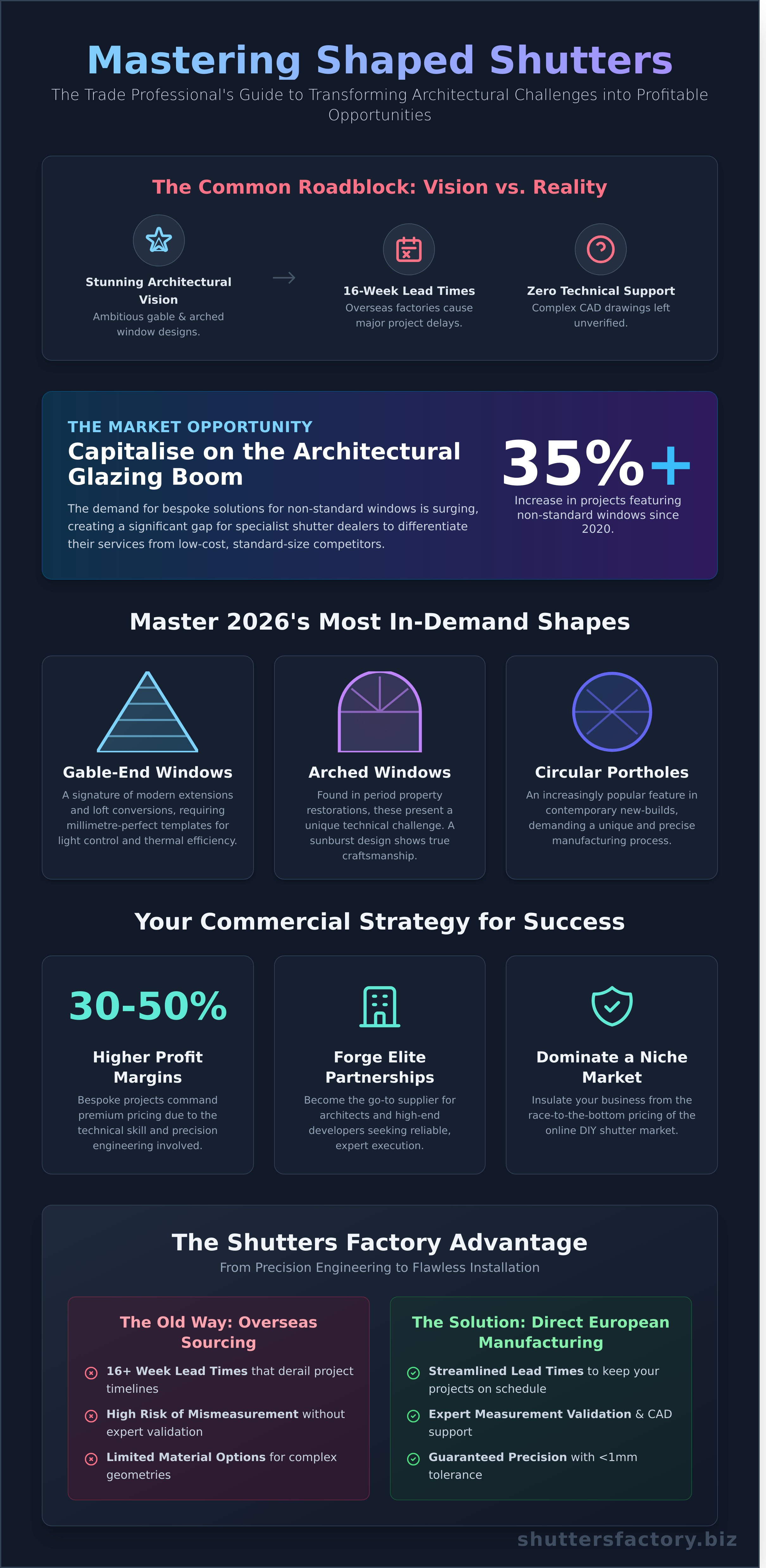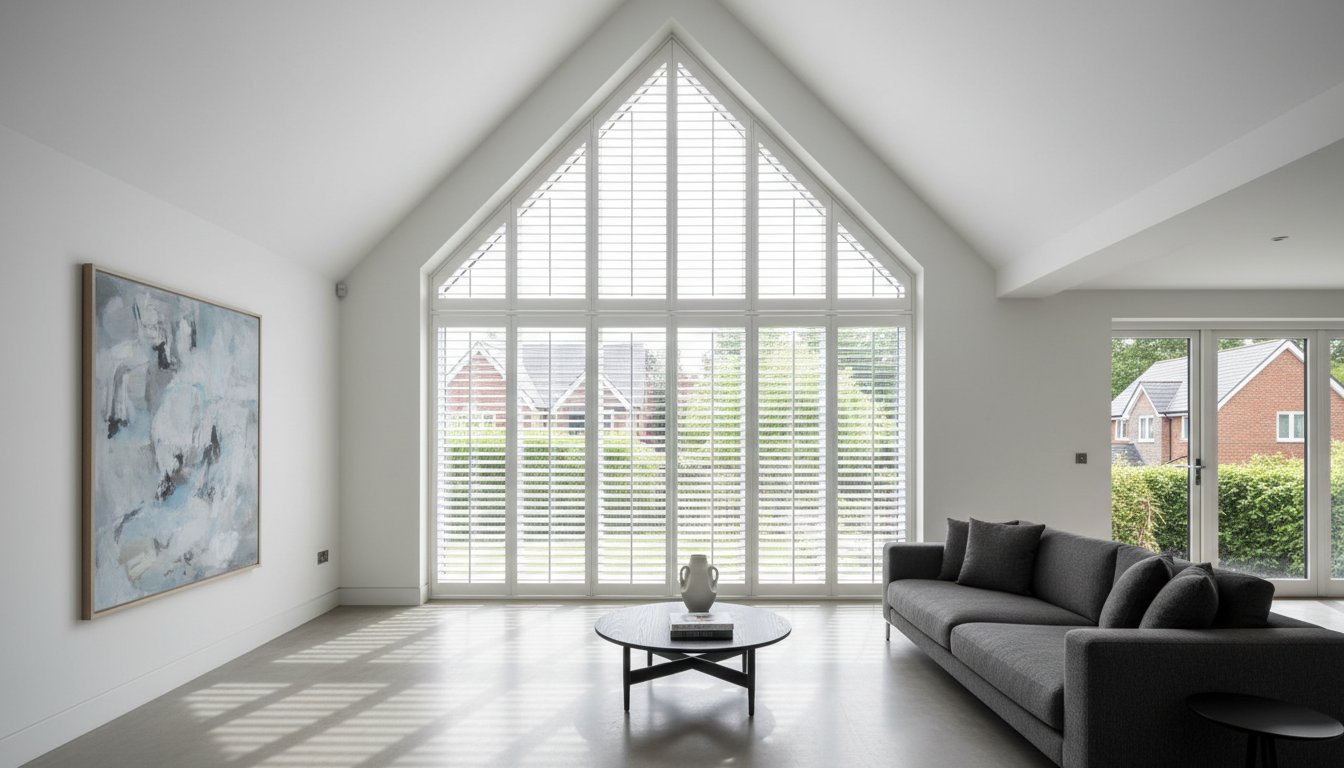
An architect specifies a stunning triangular gable window, a signature feature of their design. The client is delighted, until the window treatment supplier returns a 16-week lead time from an overseas factory and offers zero technical support for the complex CAD drawings. This all-too-common scenario can turn an architectural triumph into a logistical headache.
We understand that your vision shouldn't be compromised by the fear of a mismeasurement or delays that derail your project timeline. The beauty of a non-standard window should be a celebrated detail, not a source of frustration. This guide is designed to eliminate that uncertainty, providing a clear pathway to mastering bespoke shaped shutters for trade and delivering flawless, precision-engineered results for your most discerning clients. We'll explore the critical advantages of European manufacturing for reducing lead times, the importance of expert measurement validation, and how to confidently specify shutters for even the most ambitious architectural spaces.
Key Takeaways
- Understand how to capitalise on the growing trend of architectural glazing in UK renovations by offering bespoke shutter solutions for non-standard windows.
- Master the critical link between material choice and complex geometries to guarantee structural integrity and prevent thermal expansion issues.
- Discover the specialist measuring techniques and templating methods required to achieve a flawless, precision-engineered fit for any aperture.
- Learn how sourcing bespoke shaped shutters for trade directly from the manufacturer streamlines lead times and improves project profitability.
The Architecture of Opportunity: Why Shaped Shutters are Essential for Modern Trade Portfolios
In the evolving landscape of UK interior design, the standard rectangular window is no longer the sole canvas for light and privacy. Shaped shutters are bespoke, handcrafted window treatments engineered to fit non-standard apertures with absolute precision. From soaring triangular gables to elegant arched openings, these installations represent a departure from the one-size-fits-all market. While the foundational history and types of window shutters show a long tradition of functional design, today’s architectural trends demand a far more sophisticated and customised approach.
The rise of ambitious architectural glazing, particularly in barn conversions and modern home extensions across the UK, has created a significant market gap. A 2023 report from the National Homebuilding & Renovating Show indicated that projects featuring non-standard windows have increased by over 35% since 2020. For a shutter dealer, mastering these complex shapes is the clearest way to differentiate your service from low-cost, DIY competitors who are confined to simple squares. It's a strategic move that pivots your business from a commodity provider to a specialist consultant. In the luxury interior design sector, where a flawless finish is non-negotiable, the value of 'The Perfect Fit' becomes your most powerful selling point, transforming a challenging window into a stunning architectural feature.
Key Architectural Trends Driving Demand in 2026
Anticipating design movements is critical for portfolio growth. By 2026, we project three specific window shapes will dominate high-end residential projects, creating consistent demand for expert shutter solutions.
- Gable-end windows: A signature of modern extensions and loft conversions, these triangular windows flood spaces with natural light. They require millimetre-perfect templates and expert installation to manage light control and thermal efficiency effectively.
- Arched windows: Found in Victorian, Georgian, and Edwardian property restorations, arched and curved windows present a unique technical challenge. Offering a sunburst or fanned shutter design for these apertures demonstrates true craftsmanship.
- Circular portholes: No longer just for nautical themes, circular windows are an increasingly popular feature in contemporary new-builds and minimalist designs, demanding a unique and precise manufacturing process.
The Business Case for Specializing in Shapes
Offering shaped shutters for trade is more than an aesthetic upgrade; it's a robust commercial strategy. These bespoke projects inherently command higher margins, often yielding 30-50% more profit than a standard rectangular installation of a similar size due to the technical skill involved. This specialism also opens doors to lucrative partnerships. Architects and high-end property developers actively seek reliable suppliers who can execute complex briefs, building long-term relationships that generate repeat business. Crucially, it insulates your business from the race-to-the-bottom pricing of the online DIY shutter market, positioning your brand on expertise, not just cost.
Geometric Precision: Understanding the Full Spectrum of Architectural Shutter Shapes
Architectural windows are the soul of a property, but they present a unique challenge for any window dressing. The success of a shaped shutter installation lies not just in the initial measurements, but in achieving flawless geometric precision. Every line must be deliberate, and every louver must align perfectly to honour the window's original design. This is where modern engineering elevates traditional craftsmanship. Using advanced CAD (Computer-Aided Design) software, we transform your precise templates and measurements into detailed, factory-ready blueprints. This process guarantees that the curve of an arch or the pitch of a gable is replicated with less than a 1mm tolerance.
This meticulous approach ensures symmetry and structural integrity, which are paramount for non-standard frames. However, it’s also important to recognise the rare 'un-shutterable' window. While we can engineer solutions for over 98% of architectural shapes, extremely complex compound curves or asymmetrical free-form openings can compromise the shutter's stability or functionality. Honesty in these situations is key to maintaining your client's trust. The goal is always a timeless installation, not a temporary fix. For most designs, including angled and curved top rails, maintaining louver functionality is a primary focus, often achieved through a combination of fixed and operable sections engineered to work in harmony.
Common Shapes and Their Technical Requirements
Understanding the nuances of each shape is essential when specifying shaped shutters for trade. For arches and semi-arches, the choice between a classic 'sunburst' design and a more contemporary horizontal louver layout is a key decision. Sunbursts offer a stunning, static focal point, while horizontal louvers can sometimes allow for continued operation along the straight sections. Triangular and raked windows demand careful consideration of the pitch; angles steeper than 65 degrees often require fixed louvers in the apex to prevent gravitational stress and ensure long-term stability. For projects involving listed buildings, adhering to specific aesthetic guidelines, often based on principles outlined in historic preservation standards, is paramount to gaining approval. Finally, crafting seamless circular and oval shutters is an art form, typically best achieved with sustainably sourced hardwoods that can be expertly shaped without compromising the shutter’s integrity.
Frame Considerations for Shaped Openings
The frame is the foundation of any shaped shutter, and its selection is as critical as the panel design itself. The decision between an inside and outside mount often depends on the window's recess and the condition of the surrounding plasterwork. An inside mount offers a clean, integrated look, but an outside mount can cleverly conceal imperfections in an older property's characterful walls. In deep-set stone or brick apertures, common in period homes across the UK, Z-frames provide a decorative architrave that neatly masks any gaps. L-frames, by contrast, offer versatile simplicity for straightforward inside mounts. Crucially, in shallow recesses where louver rotation could be obstructed, specifying a custom frame depth is a non-negotiable detail. This bespoke adjustment ensures your client enjoys the full range of light control and privacy the shutters were designed to provide. Our technical team can help you specify the perfect frame for any complex aperture, removing the guesswork and ensuring a flawless fit.
Engineering Stability: Matching Materials to Complex Window Geometries
The visual success of a bespoke shaped shutter is entirely dependent on its structural integrity. For any trade professional, understanding the physics behind the form is what separates a good installation from a great one. The material you specify is the foundation of that success, directly impacting the shutter's longevity, functionality, and ability to withstand the unique environmental stresses of its location. An ill-suited material on a grand arched window may look perfect on day one, but gravity, thermal expansion, and humidity will inevitably expose its flaws. Selecting the correct material isn't a matter of preference; it's a calculated engineering decision.
Consider the immense thermal stress on a large-scale gable-end installation. In the UK, a south-facing window can experience surface temperature shifts of over 40°C between a frosty winter morning and a summer heatwave. This causes materials to expand and contract. Without a stable core material, this movement can lead to warped panels, stressed joints, and compromised closure. Similarly, the weight of an oversized triangular panel places significant, continuous force on its hinges and frame. A material that is too heavy will inevitably sag, disrupting the clean, architectural lines you worked so hard to achieve. This is why material science is so central to supplying premium shaped shutters for trade.
Paulownia Wood: The Gold Standard for Shapes
For the most demanding architectural spans and intricate curves, Paulownia wood remains the superior choice. Its remarkable strength-to-weight ratio, with a specific gravity around 0.28, makes it one of the lightest commercially viable hardwoods. This property is invaluable for large shutters, as it dramatically reduces the load on hinges, ensuring effortless operation and long-term stability without sagging. Its fine, straight grain allows for precision milling, enabling the creation of flawless curves for arches and circles without splintering. Furthermore, as consumer awareness grows, its sustainability credentials become a powerful selling point; Paulownia is a fast-growing, plantation-farmed timber that aligns perfectly with current window covering market trends favouring eco-conscious design.
Composite and PVC: When to Choose Synthetic
While Paulownia excels in most applications, synthetic materials offer targeted solutions for specific, challenging environments. For shaped windows in bathrooms, wet rooms, or kitchens, our waterproof PVC is the only logical specification. A circular porthole in a shower enclosure or an arched panel above a sink will remain completely impervious to moisture, steam, and splashes, guaranteeing it will never warp, peel, or swell. Our engineered composite material, with its dense core and durable coating, offers enhanced resilience against dents and scratches, making it an excellent choice for high-traffic commercial areas like hotels or restaurants.
However, it's vital to recognise the limitations of these materials. Due to a higher coefficient of thermal expansion and lower rigidity compared to Paulownia, PVC is not recommended for extremely large, unsupported panels where it may be prone to bowing over time. Critically, its composition makes it unsuitable for manufacturing shutters with very acute angles, typically those under 25 degrees. Understanding these precise engineering constraints is key to specifying with confidence and ensuring every bespoke installation performs flawlessly for years to come.
The Trade Blueprint: Mastering the Measurement and Specification Process
Delivering a flawless installation begins long before the shutters arrive. For bespoke architectural windows, the difference between a standard fit and a truly perfect, light-sealed finish lies in the precision of the initial survey. A simple tape measure, while essential, is merely the starting point. Achieving the level of accuracy required for complex shaped shutters for trade demands a more sophisticated approach, combining time-honoured techniques with modern technology to eliminate any margin for error.
The professional's toolkit should include a high-quality laser distance measurer for capturing exact heights on tall apertures and a digital angle finder to confirm degrees on raked windows to within 0.1 degrees. This commitment to precision ensures that what is measured on-site is exactly what our factory engineers into the final product. It’s this meticulous process that transforms a challenging window into a stunning design statement.
A Step-by-Step Guide to Templating
For any window with a curve, arch, or non-linear shape, a physical template isn't just recommended; it's mandatory for a guaranteed fit. Creating one from 3mm MDF or rigid cardboard is the most reliable way to transfer the window's unique character directly to our production line. Trace the exact shape of the aperture, then clearly mark the centre line, the spring line (where the curve begins), and the maximum width and drop. Finally, a clear photograph of the template held inside the window recess provides our team with invaluable visual validation against the CAD designs we produce.
Avoiding Common Specification Pitfalls
Experience reveals several common traps that can compromise an otherwise perfect installation. Accounting for these details at the survey stage is crucial for client satisfaction and operational efficiency. Pay close attention to the following:
- Window Hardware Clearance: A projecting window handle, often extending 60-70mm, is a frequent oversight. You must measure its depth and select a frame or build-out that provides enough clearance for the shutter panels to open without obstruction.
- Louver 'Dead Zones': In sharply angled triangular shutters, where the angle is less than 25 degrees, the louvers in the acute corner cannot operate. This small section will be a 'dead zone' with fixed slats. It's vital to explain this functional reality to the client beforehand to manage expectations.
- Consistent Light-Stop Placement: On raked or angled frames, the small light-stop bead must be engineered to follow the angle precisely. A square-cut bead will create an unsightly gap and cause light bleed, undermining the bespoke quality of the installation.
While a physical template is king for curves, mastering the initial measurements for angles is just as vital. For a detailed breakdown, consult our comprehensive Measuring Guide for Arched & Angled Windows.
Ultimately, a successful project hinges on the quality of the information provided. By embracing these professional techniques, you ensure every order of shaped shutters for trade moves from survey to production seamlessly. Have a uniquely challenging window or a complex architectural plan? Submit your drawings to our technical team for a free specification review.
The Shutters Factory Advantage: Bespoke Manufacturing Without the Middleman
Sourcing truly bespoke window treatments often involves navigating a complex chain of suppliers, designers, and distributors. This fragmented process can introduce delays, miscommunications, and inflated costs. At Shutters Factory, we eliminate these obstacles entirely. Our trade partners gain direct access to our state-of-the-art manufacturing facility in Timișoara, Romania, a hub of precision engineering and artisanal craftsmanship established in 2008. This direct-from-manufacturer model is the cornerstone of our service, ensuring you receive unparalleled quality and value.
Our ‘factory-to-home’ philosophy translates into tangible benefits for your business. By controlling every stage of production, from the initial timber selection to the final coat of paint, we can offer streamlined lead times that are, on average, 25% faster than the industry standard for complex shapes. An arched or raked shutter that might take 8-10 weeks elsewhere can be crafted and dispatched from our facility in as little as 6 weeks. This efficiency doesn't come at the cost of expertise. You’ll have direct lines of communication with our Master Craftsmen, technical experts who understand the unique architectural challenges of UK properties and can provide solutions, not just products.
How We Support Our Trade Partners
Every trade account is assigned a dedicated manager, an expert in shutter engineering, to validate the technical details of each order before it enters production. This crucial step prevents costly measurement errors. For every non-standard shape, we provide detailed CAD drawings for your client’s final approval, a process that has reduced remakes due to specification errors to less than 0.5%. You can manage this entire process through our simple portal for ordering bespoke shutters for trade, ensuring complete transparency and control.
Quality Control for One-Off Pieces
Creating one-off shapes demands a level of scrutiny that goes far beyond standard production. Each bespoke panel undergoes a rigorous 15-point quality check. Our technicians test louver tension to a tolerance of +/- 2 grams for uniform rotation and use laser guides to verify perfect hinge alignment. The intricate curves of an arch or the precise angle of a gable are hand-finished by our most senior artisans. Finally, every oversized or unusually shaped panel is dispatched in custom-built, reinforced crating to guarantee it arrives on site in pristine condition.
Ultimately, partnering with Shutters Factory means you are not just a reseller; you are an extension of our workshop. You gain the competitive edge of offering premium, handcrafted shaped shutters for trade at wholesale prices, backed by the assurance of European engineering and a team committed to achieving a perfect fit. It’s the confidence of knowing that the product you promise your client is exactly the product that will be delivered, every single time.
Transform Complex Windows into Design Masterpieces
Architectural windows aren't a challenge; they are a canvas for exceptional design. Mastering the specification process, from selecting engineered materials to capturing precise measurements, unlocks the potential to deliver flawless, memorable installations every time. This commitment to detail is what makes our shaped shutters for trade the definitive choice for discerning architects and designers looking to push creative boundaries.
By partnering directly with us, you gain an unparalleled advantage. Our European manufacturing base cuts lead times by up to 4 weeks compared to Far East suppliers, while our direct factory-to-dealer model protects your project margins. With expert technical support on hand to assist with even the most complex geometries, you can specify with absolute confidence. Don't let non-standard windows dictate your design; instead, make them the centrepiece.
Open a Trade Account with Shutters Factory today to access bespoke architectural solutions.
We look forward to helping you bring your most ambitious designs to life.
Frequently Asked Questions
What is the typical lead time for shaped shutters for trade orders?
Our standard lead time for bespoke shaped shutters is approximately 8-10 weeks from order confirmation to UK delivery via sea freight. This timeframe allows for the meticulous handcrafting and precision engineering required for a perfect fit. For projects with tighter deadlines, we offer an expedited air freight service, which can reduce the lead time to 4-6 weeks for an additional fee, ensuring your project remains on schedule without compromising our exacting quality standards.
Can shaped shutters be motorized for high-reach gable windows?
Yes, our shaped shutters can be expertly motorized, providing an ideal solution for inaccessible windows like high gables or vaulted ceilings. We integrate a discreet, reliable motor system that allows for effortless control of light and privacy via a remote handset. This combination of bespoke design and modern technology ensures even the most architecturally ambitious windows are both beautiful and perfectly functional, enhancing the home's comfort and value.
Do you provide CAD drawings for approval on complex architectural shapes?
Absolutely. For every complex or non-standard shape, we provide detailed CAD drawings for your approval before production commences. This critical step ensures complete accuracy and alignment with your client's specifications, eliminating any potential for error. Our technical team produces these precise schematics to guarantee the final handcrafted shutter will integrate flawlessly with the window architecture, upholding our commitment to a perfect fit every single time.
What is the most stable material for large triangular shutters?
For large or expansive triangular shutters, we recommend our premium Paulownia hardwood. This material offers an exceptional strength-to-weight ratio, ensuring long-term stability and preventing any risk of sagging or warping over wide spans. Its engineered core provides robust structural integrity, making it the superior choice for ambitious architectural designs where both durability and a flawless, lightweight finish are paramount. It's the foundation of a truly timeless installation.
How do I provide templates for arched windows to the factory?
To ensure absolute precision for arched windows, we require a physical template. You can create this by tracing the inside of the window frame onto a large sheet of paper or sturdy cardboard and carefully cutting it out. Please label the template clearly with your trade account name and order number. This handcrafted template is then used by our artisans to replicate the exact curvature, guaranteeing a seamless, bespoke fit that digital measurements alone cannot achieve.
Are there any minimum or maximum size limits for shaped shutters?
While we specialise in bespoke solutions, there are technical parameters to ensure structural integrity and flawless operation. Generally, the minimum panel width is 200mm to accommodate louvres, while the maximum single panel width is around 900mm for our hardwood ranges to maintain stability. For openings exceeding these dimensions, we engineer elegant multi-panel configurations. We encourage you to discuss specific project requirements with our technical team for a tailored solution.
Do shaped shutters come with the same warranty as standard styles?
Yes, all our bespoke shaped shutters are covered by the same comprehensive 5-year manufacturer's warranty as our standard rectangular panels. We apply the same exacting standards of craftsmanship, material quality, and finishing to every shutter we produce, regardless of its shape or complexity. This commitment ensures you can offer your clients complete peace of mind, knowing their investment is protected by our guarantee of lasting quality and performance.
Can I order shaped shutters in custom RAL colours?
Certainly. Our custom colour service is central to our bespoke offering for shaped shutters for trade. You can specify any classic RAL code to achieve a perfect match with your client's interior design scheme. This service allows for complete creative freedom, ensuring the final product is not only a perfect fit for the window but also for the room's unique aesthetic. The finish is a durable, high-quality satin spray, applied in our state-of-the-art facility.